Defiance: The Prison Memoirs of Savitri Devi (The Centennial Edition of Savitri Devi's Works, Volume 4) by Savitri Devi
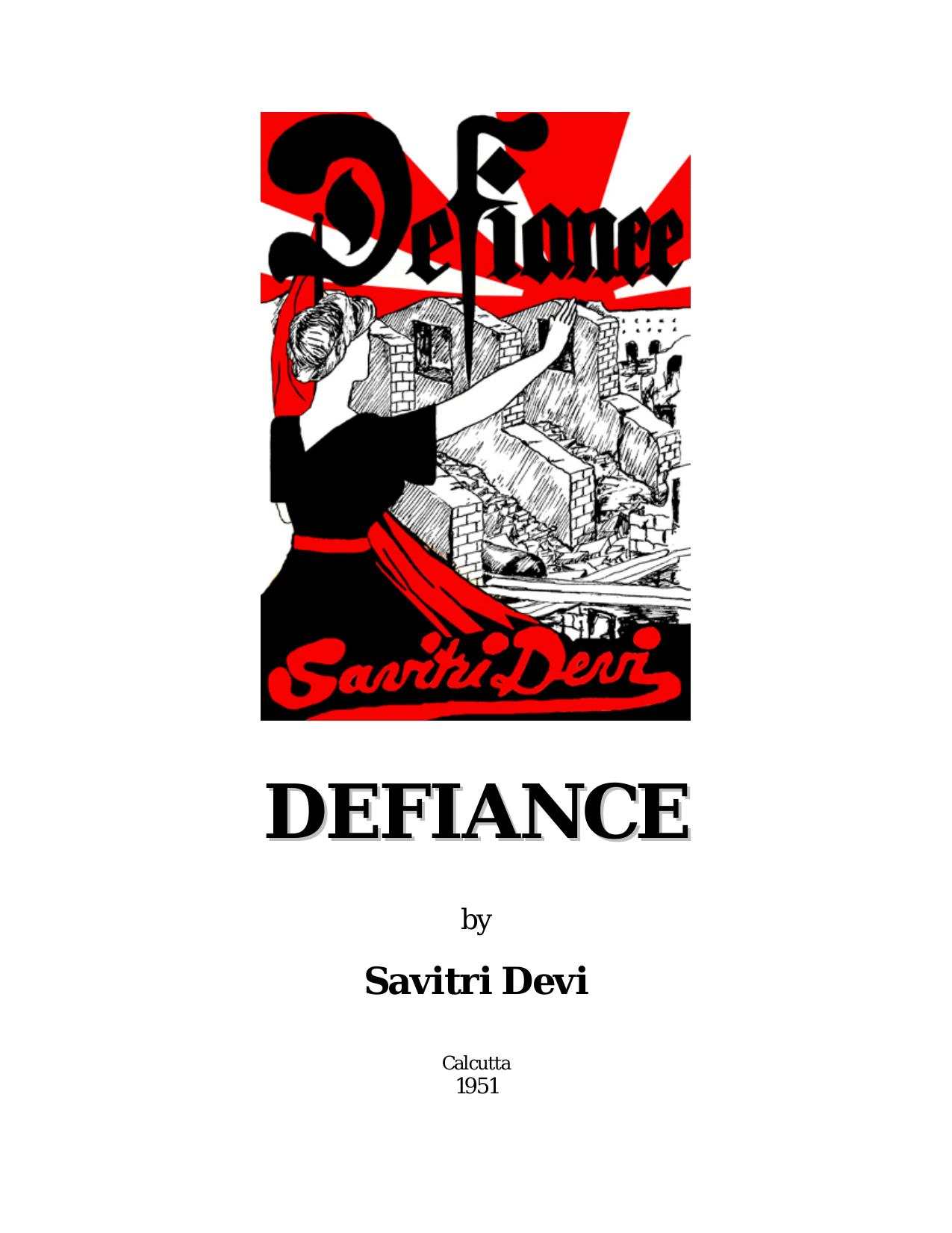
Author:Savitri Devi
Language: eng
Format: mobi, epub, pdf
Tags: iron_pill_short
ISBN: 9780974626468
Publisher: The Savitri Devi Archive
Published: 2008-07-15T00:00:00+00:00
* * *
The woman did not come back. But she left me a few issues of
Life, one of which contained a long extract from Winston Churchill’s
War Memoirs. In it, the British ex-Premier tried his best to explain
that the Führer’s orders to stop the rush of the German armoured
divisions to Dunkirk — the orders that resulted in “clearing the way
for the British Army,” — were taken on the initiative of General
Runstedt, and inspired by anything but the desire to show generosity
to England as I had somewhere stated in the third chapter of my Gold
in the Furnace. He buttressed his deductions, — he said — upon the
“actual diary of General Runstedt’s Headquarters, written at the
time.” But as I read that, I suddenly recalled what Miss Taylor had
told me of the privileges granted by the British authorities to the so-
called “war criminal” General Runstedt, in particular, his leave from
prison on parole. And I also recalled Colonel Vickers’ statement to
me, on Wednesday morning, the 6th of April, 1949: “Political
prisoners are the last people to whom we grant special privileges . . .
save in the case they write for us or do some secret work for us, in
one way or another” (sic). I could not help . . . “putting two and two
together”
302
and wondering whether General Runstedt’s alleged “diary,” supposed
to be “written at the time,” were not just another piece of “secret
work” in the interest of the British thesis about the events, written in
confinement after the war — “secret work” of the kind Colonel
Vickers had had in mind on that morning of the 6th of April. That
would no doubt justify all sorts of privileges (if what Miss Taylor had
told me were true), thought I, without wishing to be unnecessarily
malignant, or even suspicious. And I added a footnote to the page in
my Chapter 3 in which I had mentioned Dunkirk.
In another issue of the same magazine, I found an account of
the disgraceful manner in which the American Police had recently
forced Walter Gieseking, the great German pianist, to leave the U.S.A.
on account of his allegiance to National Socialism. Public
demonstrations, headed, as could be expected, by Jews, had taken
place in front of the hall in which he was to play. And the authorities
had abruptly postponed the musical performance until an
“investigation into his case” would give satisfactory assurances as to
the artist’s “de-Nazification” — which, of course, might have taken a
month or more. In answer to which, Herr Gieseking had departed
from the U.S.A. by the first plane, utterly disgusted with American
behaviour. “And rightly so,” thought I; “for all this fuss, now, nearly
four years after the end of the war, in a country alleged to have fought
for “individual liberties,” “human rights,” and what not, is enough to
make one sick! From the very point of view of those who boast of
democratic liberalism, had not the German artist every right to be a
Nazi, if such were his convictions?” And for the millionth time, I
pondered over the irreducible inconsistency of the Democrats’
position: in accordance with their loudly professed principles, these
people simply
303
have to acknowledge our
Download
Defiance: The Prison Memoirs of Savitri Devi (The Centennial Edition of Savitri Devi's Works, Volume 4) by Savitri Devi.epub
Defiance: The Prison Memoirs of Savitri Devi (The Centennial Edition of Savitri Devi's Works, Volume 4) by Savitri Devi.pdf
This site does not store any files on its server. We only index and link to content provided by other sites. Please contact the content providers to delete copyright contents if any and email us, we'll remove relevant links or contents immediately.
| Anthropology | Archaeology |
| Philosophy | Politics & Government |
| Social Sciences | Sociology |
| Women's Studies |
The Secret History by Donna Tartt(19471)
The Social Justice Warrior Handbook by Lisa De Pasquale(12294)
Thirteen Reasons Why by Jay Asher(9122)
This Is How You Lose Her by Junot Diaz(7057)
Weapons of Math Destruction by Cathy O'Neil(6469)
Zero to One by Peter Thiel(5952)
Beartown by Fredrik Backman(5941)
The Myth of the Strong Leader by Archie Brown(5625)
The Fire Next Time by James Baldwin(5589)
How Democracies Die by Steven Levitsky & Daniel Ziblatt(5322)
Promise Me, Dad by Joe Biden(5230)
Stone's Rules by Roger Stone(5191)
A Higher Loyalty: Truth, Lies, and Leadership by James Comey(5090)
100 Deadly Skills by Clint Emerson(5023)
Rise and Kill First by Ronen Bergman(4905)
Secrecy World by Jake Bernstein(4889)
The David Icke Guide to the Global Conspiracy (and how to end it) by David Icke(4851)
The Doomsday Machine by Daniel Ellsberg(4624)
The Farm by Tom Rob Smith(4611)
